The Sociology of Accidents: How Organizational Hierarchies Shape Safety
Accidents rarely begin with a single mistake.
More often, they begin with silence, delay, uncertainty, or a decision that moves through the organization without enough friction. A supervisor assumes a contractor has been cleared. Procurement assumes Safety reviewed the documentation. Operations assumes the certificate of insurance is current because the job was already scheduled. A frontline worker sees something questionable but wonders whether speaking up will slow the work or create conflict.
That is the sociology of accidents: the way organizational structure, authority, communication, and access to information shape safety outcomes before an incident ever occurs.
For EHS, Risk, Procurement, and Operations leaders in the United States, this matters because contractor safety management is not only a documentation issue. It is a decision-making issue. When contractor prequalification, COI tracking, training documentation, and audit readiness depend on manual follow-up or inconsistent review, risk does not stay neatly contained inside a spreadsheet. It moves into the field.
Safety Is Shaped by the System Around the Work
The U.S. has made meaningful progress in workplace safety over the last several decades, but serious risk remains. The Bureau of Labor Statistics reported 5,070 fatal work injuries in the United States in 2024, with a fatal injury rate of 3.3 per 100,000 full-time equivalent workers. That is an improvement from 2023, but it still represents thousands of families, teams, and organizations changed by preventable loss. (Bureau of Labor Statistics)
At the same time, OSHA’s most frequently cited standards continue to point to familiar gaps: fall protection, hazard communication, lockout/tagout, respiratory protection, powered industrial trucks, eye and face protection, and machine guarding. These are not obscure risks. They are well-known, well-documented, and still difficult to manage consistently across complex work environments. (OSHA)
That is where hierarchy enters the conversation. In many organizations, safety expectations are clear on paper but harder to apply under pressure. Decisions pass through multiple layers: leadership, operations, procurement, EHS, site supervisors, contractors, and contractor employees. Each layer has its own priorities, deadlines, and assumptions. The more fragmented the process, the easier it becomes for someone to believe that someone else handled the risk.
The Real Risk Is Often Ambiguity
Most safety leaders do not struggle because they lack commitment. They struggle because the systems around them create ambiguity.
A contractor may be needed quickly. A project may be behind schedule. A plant outage may have a narrow work window. A procurement team may be focused on availability and cost. A supervisor may be trying to keep work moving. None of those pressures are unusual. But when contractor information is incomplete, outdated, or scattered across email chains and spreadsheets, those pressures can subtly reshape safety decisions.
Ask yourself: when a contractor arrives onsite, can your team quickly confirm whether that contractor is prequalified, whether required insurance documentation meets your specifications, and whether site-specific orientation has been completed?
If the answer depends on who is working that day, where the document was saved, or who remembers the latest status, the organization has a structural problem - not just an administrative one.
This is why manual contractor tracking creates more than inefficiency. It creates uneven authority. Some people have access to the right information; others do not. Some locations enforce requirements tightly; others rely on informal workarounds. Some teams stop work when a record is missing while others assume the risk has already been reviewed. Over time, this inconsistency becomes part of the safety culture.
Why Speaking Up Depends on More Than Courage
OSHA’s guidance on worker participation emphasizes that employees should be able to report hazards, participate in safety programs, and raise concerns without fear of retaliation. It also notes that organizations should provide time, resources, feedback, and policies that support participation from all levels of the workforce. (OSHA)
That guidance is important because “speak up culture” is often discussed as if it depends only on individual courage. In reality, people speak up when the organization makes it practical and safe to do so.
If a frontline employee believes contractor documentation is incomplete, where does that concern go? If a supervisor sees that a contractor employee has not completed orientation, is the next step clear? If a COI is expired, does Operations know before the work is scheduled? If a contractor’s safety documentation needs additional review, does Procurement have visibility before selection? These are not abstract cultural questions. They are operational questions.
A strong contractor safety management process reduces the need for people to challenge the hierarchy in the first place. It gives them structure, visibility, and documented requirements before the pressure point arrives.
Contractor Management Is a Cross-Functional Safety Control
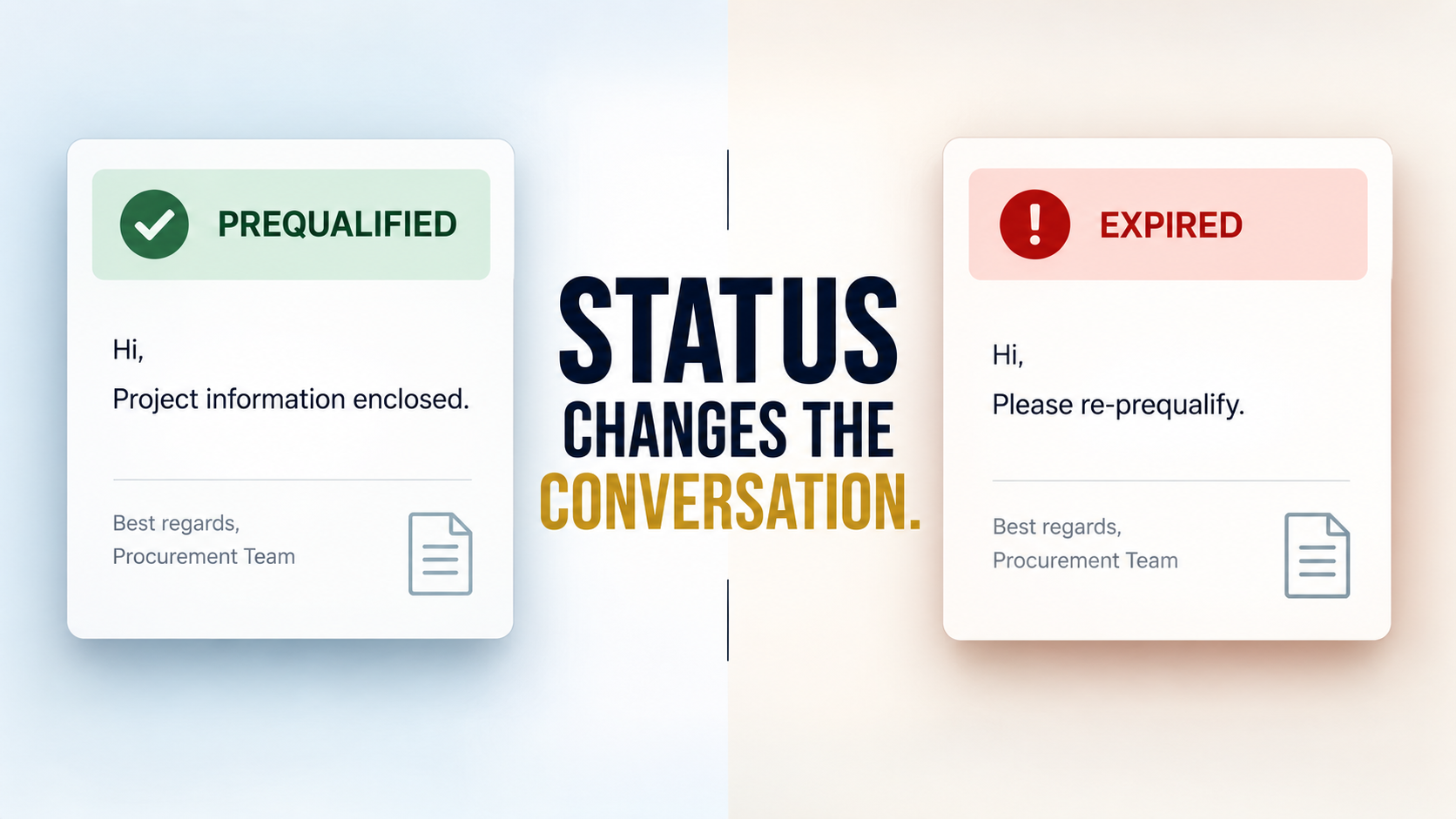
Contractor prequalification is often treated as a back-office function, but that undersells its importance. In high-hazard environments, prequalification is one of the first safety controls in the work process. It helps determine whether a contractor has submitted the business information, safety documentation, insurance information, licenses, certifications, and supporting records required by the hiring organization.
NIOSH’s hierarchy of controls reminds safety professionals that the most effective controls reduce exposure without relying heavily on individual behavior. Administrative controls and PPE have a role, but stronger systems reduce dependence on last-minute human judgment (CDC). Contractor prequalification works in that same spirit: it creates structure before work begins.
The problem is that many organizations still manage this structure through manual effort. They collect documents, chase renewals, send reminder emails, update spreadsheets, and try to reconcile status across departments. That process may function when contractor volume is low, but it becomes fragile as the organization grows across sites, business units, and work types.
What happens when one location accepts a contractor based on outdated information while another location requires updated records? What message does that send to supervisors, contractors, and employees about which requirements are truly mandatory? Safety consistency depends on process consistency.
How FIRST, VERIFY Supports Clearer Contractor Decisions
FIRST, VERIFY helps organizations bring structure to contractor management by providing a rules-based contractor prequalification process. The system collects contractor business information, safety documentation, and required supporting records; uses client-defined requirements to determine qualification status; applies templates so contractors provide the correct details; and supports annual renewal to help keep information current. This reduces administrative burden while improving consistency for safety and procurement teams.
That consistency matters because it limits informal decision-making. Instead of asking each site or department to interpret requirements differently, organizations can use defined templates and qualification criteria. Instead of depending on scattered files, teams can access contractor information through a centralized structure.
FIRST, VERIFY also supports centralized safety and compliance data, including COIs, bonding limits, licenses and certifications, business details, references, financial information, master agreements and associated forms, and audit reports when audits are part of the client’s program. This type of visibility helps EHS, Risk, Procurement, and Operations work from the same information rather than separate versions of the truth.
It is important to be precise: FIRST, VERIFY does not provide predictive analytics, real-time behavioral monitoring, or near-miss reporting. Its value is more practical and immediate. It helps organizations collect, organize, verify, and update contractor compliance information so teams can make clearer decisions before work begins.
COI Management Shows How Small Gaps Become Larger Risks
Certificates of insurance (COIs) are a useful example of how hierarchy, documentation, and safety intersect. A missing or expired COI may appear to be an insurance issue, but in practice it can become an operations issue, a risk issue, and a work-delay issue.
When COI tracking is manual, responsibility can blur. Procurement may assume Risk reviewed the document. Risk may assume the contractor uploaded a current version. Operations may assume approval was already granted because the contractor is scheduled. By the time the issue is discovered, the organization may be facing a delay, an exception request, or an uncomfortable decision.
FIRST, VERIFY’s COI management capabilities include collecting COIs and required supporting documents, verifying insurance details against client specifications, providing reminders for expiring insurance policies, and displaying insurance compliance within each contractor’s profile. That does not remove the need for leadership judgment, but it gives decision-makers better information at the moment they need it.
Training Documentation and Orientation Reduce Field-Level Uncertainty
Contractor onboarding is another place where organizational sociology becomes visible. If orientation records are unclear, the burden shifts to supervisors and frontline personnel. They must determine whether someone is ready for the work environment while also managing the demands of the job.
FIRST, VERIFY supports online, site-specific safety orientation by hosting orientation content, supporting quizzes with pass/fail tracking, using policy acknowledgment forms when quizzes are not used, providing downloadable completion certificates, reporting by contractor, employee, course, and date, and sending automated renewal reminders.
For U.S. organizations managing contractors across multiple locations, this is not just convenient. It strengthens audit readiness, supports onboarding consistency, and reduces the likelihood that training documentation becomes a field-level guessing game.
Stronger Safety Cultures Are Built Before the Moment of Risk
The sociology of accidents teaches a simple lesson: people make decisions inside systems. If the system is unclear, rushed, fragmented, or overly dependent on memory, the decisions inside that system become less reliable.
A better approach starts before work begins. Standardize contractor prequalification. Make COI status visible. Centralize safety and compliance data. Document orientation completion. Review safety programs through remote audits when that level of oversight is needed. Build annual renewal into the process so contractor information does not become stale.
Remote safety audits can also support this structure. FIRST, VERIFY conducts offsite reviews of contractor safety programs to help clients verify how safety processes are being implemented, including documentation of safety training, demonstrated comprehension, incident investigation and discipline practices, required written safety programs, and supporting materials for inspections, investigations, and enforcement records.
The goal is not to add bureaucracy. The goal is to reduce ambiguity.
Conclusion: Safety Follows the Flow of Information
Accidents often reveal more than a failed task. They reveal how information moved, where authority sat, which assumptions went unchallenged, and whether people had the tools to make safe decisions.
For EHS, Risk, Procurement, and Operations leaders, the message is clear: contractor safety management cannot depend on fragmented documentation and informal follow-up. When work is complex, fast-moving, and high-risk, organizations need a consistent process that supports the people expected to protect the workforce.
FIRST, VERIFY helps organizations strengthen that process through contractor prequalification, centralized safety and compliance data, COI management, online safety orientation, and remote safety audits. For leaders who want to reduce uncertainty before it reaches the jobsite, that structure is not administrative overhead. It is part of how safer decisions get made.
Contact us to learn how
FIRST, VERIFY can help your organization.
You might also like