Centralized Contractor Data: The Missing Link Between Safety, Procurement, and Operations
A contractor is scheduled to begin work Monday morning. By Friday afternoon, everyone believes the paperwork is in order.
Procurement has the business information. Safety has reviewed the contractor’s safety history. Risk remembers seeing the certificate of insurance (COI). Operations has the contractor on the schedule.
Then someone asks whether the latest COI actually meets the company’s requirements.
Nobody is quite sure.
The document exists, but which version is current? Procurement searches email. Safety checks a shared folder. Operations calls someone who handled the contractor the last time it worked at the facility.
Nothing particularly unusual has happened. In fact, that is the problem.
I have seen versions of this situation often enough to recognize the underlying issue. Companies can become very good at collecting contractor information without becoming equally good at managing it. The distinction matters.
The Problem Usually Isn't Missing Data
Most established companies collect plenty of information about contractors.
They may have business details, insurance documentation, licenses and certifications, safety history, references, financial information, bonding limits, and other records required by their contractor prequalification process.
What they often lack is a common structure for that information.
Safety, Procurement, Risk, and Operations each approach a contractor from a different perspective. That makes sense. Their responsibilities are different.
Safety wants to understand whether the contractor meets established safety requirements. Procurement is concerned with qualification and business information. Risk focuses heavily on insurance. Operations wants to know whether the contractor can proceed without creating a last-minute problem.
The trouble starts when each department maintains its own version of the answer.
A spreadsheet is rarely the problem by itself. Neither is email. Neither is a shared drive. The problem is the accumulation of all three, combined with processes that depend on individual employees knowing where information lives.
That system can work surprisingly well until the person who knows where everything is stored goes on vacation, changes jobs, or simply has ten other priorities that afternoon.
Administrative Problems Have a Habit of Becoming Operational Problems
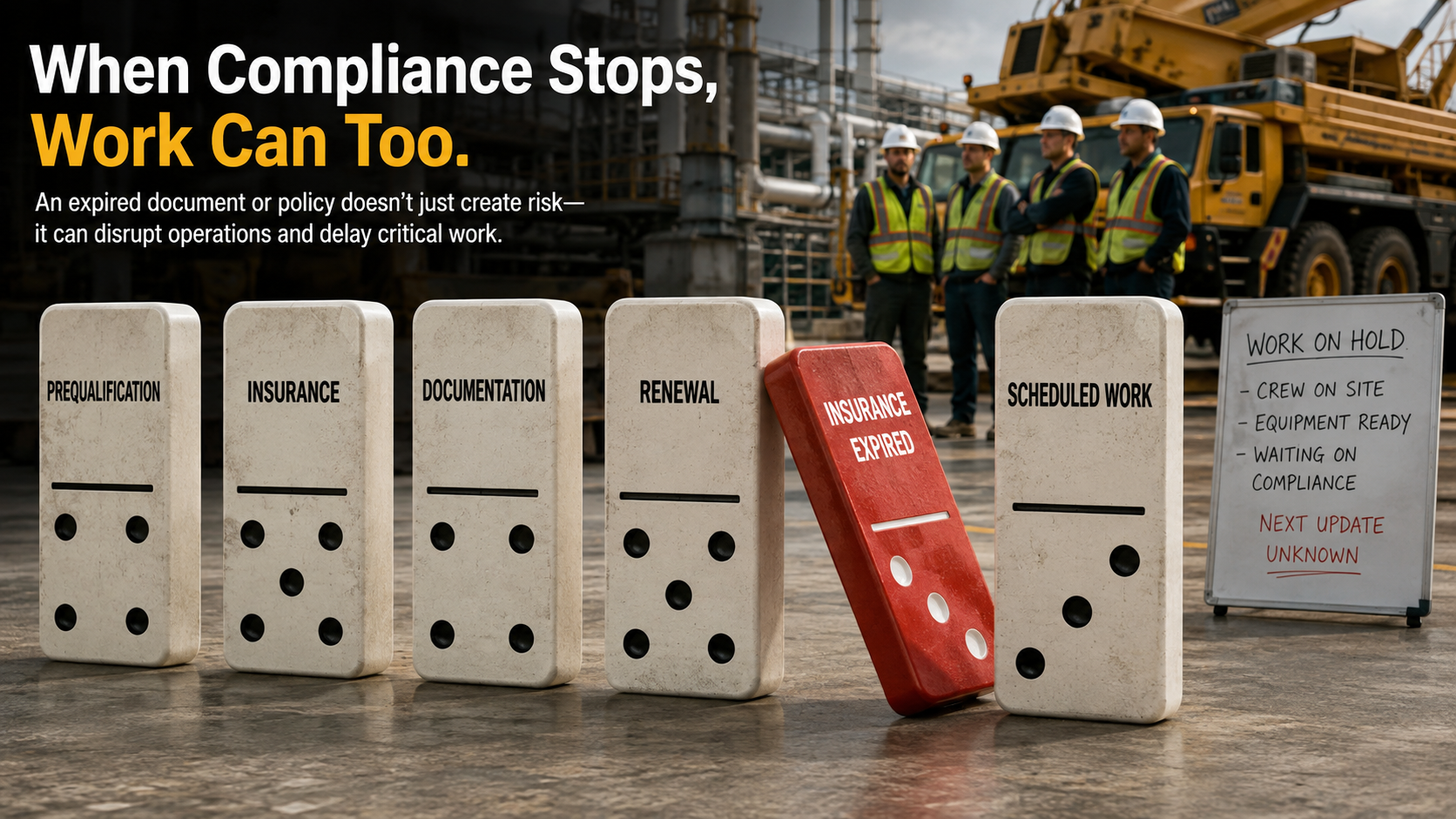
Consider an expired or noncompliant COI.
At first glance, it looks like an insurance-documentation issue. If it is identified several weeks before work begins, it can usually be handled as one.
Discover it shortly before mobilization, however, and the nature of the problem changes.
Now Operations is involved. Procurement may be calling the contractor. Risk is reviewing documentation under time pressure. Safety may be waiting for confirmation while people at the facility are asking whether work can begin.
The underlying document did not become more important overnight. The organization simply discovered the issue too late.
This is one reason information flow deserves more attention in contractor management.
OSHA makes a similar point from a safety perspective. Its Recommended Practices for Safety and Health Programs emphasize communication and coordination between host employers and contractors at multi-employer worksites because the activities of one employer can create hazards for workers employed by another. That guidance is primarily about protecting workers, but there is a broader operational lesson in it: responsibilities may be divided, but information cannot be allowed to stop at departmental boundaries.
One Contractor, Several Decisions
A useful way to think about centralized contractor data is not as a technology question, but as a decision-making question.
What does each person need to know before saying yes?
For one person, the important information may be a contractor's safety history. For another, it may be a license or certification. Someone else may need to confirm insurance requirements, while Operations simply needs to understand the contractor's current qualification status.
Those are different decisions built on overlapping information.
If your Safety and Procurement teams reviewed the same contractor this afternoon, would they be working from the same current record?
It is a simple question, but the answer reveals quite a bit about the underlying process.
Another useful question is this:
How many people need to be contacted before a site manager can confidently determine whether a contractor has completed the required prequalification process?
If the answer is three or four, the organization may have a visibility problem rather than a paperwork problem.
Centralization Is Really About Consistency
The phrase "centralized contractor data" can make the subject sound more technical than it is.
At its core, centralization means establishing one organized source for the contractor information that authorized people need.
That can include business details, COIs, licenses and certifications, safety history and documentation, financial information, bonding limits, master agreements, and prequalification status.
The important part is not merely putting those items online. It is applying a consistent process to collecting and maintaining them.
This becomes particularly important in companies with multiple locations.
Without a common process, individual facilities naturally develop their own methods. One location maintains a detailed spreadsheet. Another relies on a shared drive. A third has an experienced administrator who keeps the process moving largely from memory.
Each method may work locally. Across an organization, however, the differences make it harder to answer a basic management question: Are we applying our contractor requirements consistently?
That is one of the practical reasons FIRST, VERIFY uses a rules-based contractor prequalification process based on client-defined requirements. Contractors provide required business information, safety documentation, and supporting records through established templates, and prequalification is renewed annually. The value of that structure is less about software than about applying the same rules repeatedly.
Better Information Does Not Replace Judgment
There is an important limitation worth acknowledging.
Centralized contractor data does not tell a Safety Director everything about how a contractor will perform in the field.
Safety statistics are historical. Documents describe programs and requirements. A COI establishes information about insurance coverage; it does not establish whether someone will make the right decision while performing hazardous work.
Experienced safety professionals already understand this distinction.
OSHA recordkeeping data, for example, helps employers and workers evaluate workplace safety and understand hazards, but records are inputs into safety management not substitutes for it.
The same principle applies to contractor prequalification.
The purpose of organizing contractor data is not to eliminate professional judgment. It is to give people better information when they exercise that judgment.
In some circumstances, an organization may want additional review. FIRST, VERIFY, for example, offers remote safety audits as a separate service that examines documentation associated with safety training, comprehension, incident investigation, discipline practices, selected written safety programs, inspections, investigations, and enforcement records. That is distinct from standard prequalification and can be used when a client determines that deeper review is appropriate.
That distinction is important because not every contractor presents the same risk, and not every situation deserves the same level of scrutiny.
The Best Test Is Usually a Practical One
Organizations considering whether their contractor information is sufficiently organized can conduct a fairly simple exercise.
Choose a contractor scheduled to work in the next few weeks.
Ask someone from Safety, someone from Procurement, and someone from Operations to independently determine its current status. Ask them to locate the relevant COI, qualification information, licenses or certifications required by your process, and any other information they rely on.
Then compare the answers.
Did everyone find the same information? Was it current? How long did it take? Did anyone have to email another employee for clarification?
The exercise is more useful than a lengthy discussion about whether the current system is "centralized."
Because the real measure of a contractor information system is not how much data it contains.
It is whether the people responsible for making decisions can find the right information, understand its status, and act on it without unnecessary uncertainty.
Safety, Procurement, Risk, and Operations will always see contractors differently. Their responsibilities require them to.
The objective should not be to eliminate those differences.
It should be to make sure they are looking at the same contractor.
And if answering a straightforward question about that contractor still requires three spreadsheets, two inboxes, and a phone call, that may be the best place to start.
You might also like