The Compliance Bottleneck Nobody Owns: When Safety, Procurement, and Operations Share Contractor Responsibility
A contractor is scheduled to begin work on Monday. Procurement has the insurance certificate. Safety has reviewed the contractor's qualifications. Operations has already arranged the work schedule.
Then someone asks a simple question: Is the contractor approved to start?
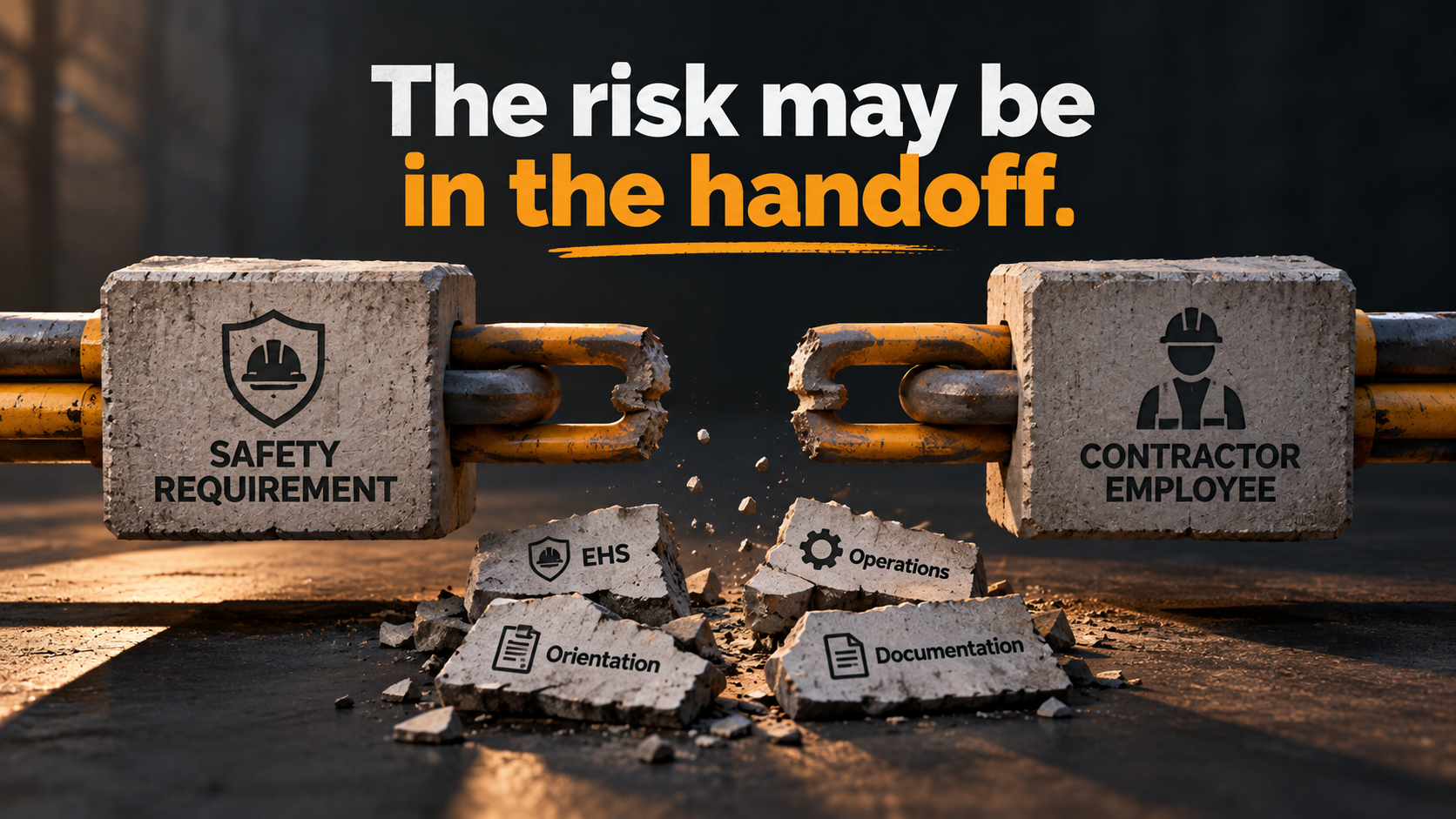
The answer should be straightforward. Instead, it takes several phone calls and emails to establish whether all the requirements have been satisfied. Nobody has necessarily made a mistake. Each department has completed the part of the process it understands to be its responsibility. The difficulty is that no one has a complete picture.
This is a familiar challenge in contractor management. It is also one that organizations can overlook because the individual tasks appear to be getting done.
The problem usually becomes visible at the point where one department needs information held by another.
When Everyone Is Responsible, Who Owns the Process?
Contractor compliance rarely belongs entirely to one department, nor should it.
Safety professionals are concerned with OSHA records, Experience Modification Rates (EMRs), safety qualifications, and the nature of the work being performed. Procurement focuses on business requirements, contractual documentation, and certificates of insurance (COIs). Operations needs to know whether contractors are qualified and ready to perform the work.
These are legitimate responsibilities, and each requires different expertise.
The difficulty arises when departments develop independent processes for managing information that other departments also need.
Procurement may maintain insurance records in a spreadsheet. Safety may track contractor prequalification separately. Operations may rely on email confirmations before scheduling work.
Over time, each process becomes familiar to the people who use it. Employees know where to find their own information, but they may not know whether another department has received updated documentation.
This creates an unusual situation: an organization can have all the required information and still struggle to make a timely decision.
The issue is not necessarily poor communication. Often, the organization has unintentionally designed a process that depends on people repeatedly communicating information that could otherwise be shared.
The Operational Cost of Fragmented Contractor Information
The obvious cost of disconnected records is administrative time. Employees request documents that have already been submitted, search through emails, and follow up on requirements another department may have addressed.
But the more important cost is uncertainty.
Consider what happens when a contractor's insurance policy approaches expiration. Procurement may have requested an updated COI, while Safety and Operations continue referencing an earlier record.
Until the information is reconciled, employees may be unsure whether the contractor meets the organization's requirements.
That uncertainty can affect scheduling, onboarding, and decisions about contractor eligibility.
The same issue arises with annual prequalification renewals, missing documentation, and changes in contractor qualification status.
There is also a less obvious consequence. When employees repeatedly encounter delays in obtaining information, they may develop informal workarounds. Personal spreadsheets, saved emails, and direct contacts become convenient ways to get answers.
Those workarounds may solve an immediate problem, but they can also make the organization more dependent on individual employees.
A process that works because one person knows where everything is stored is not necessarily a reliable process.
Contractor Compliance Is Also an Information Management Problem
Organizations often approach contractor compliance by asking whether they have established the right requirements.
That is important, but it is only part of the question.
They also need to consider how information moves through the organization after contractors submit it.
The Occupational Safety and Health Administration emphasizes communication and coordination between host employers and contractors in its Recommended Practices for Safety and Health Programs. The guidance recognizes that responsibilities and relevant safety information must be communicated clearly when multiple employers are involved.
The same principle has practical value within an organization.
If Safety determines that a contractor meets the established qualification requirements, how does Operations obtain that information? If Procurement receives updated insurance documentation, how do other authorized personnel know which record to reference?
And perhaps the most important question: Who is responsible for resolving a discrepancy when different departments have different information about the same contractor?
These are questions of organizational design as much as technology.
A centralized record can improve access to information, but it does not automatically establish who has authority to make a decision. Organizations still need clear responsibilities for reviewing documentation, addressing exceptions, and determining contractor eligibility.
Centralization Helps, but Ownership Still Matters
A practical approach is to separate responsibility for making decisions from responsibility for maintaining information.
Safety should retain responsibility for its safety-related judgments. Procurement should continue managing its assigned business and contractual requirements. Operations should remain accountable for coordinating work.
However, these departments should not need to maintain independent copies of the same contractor records.
Centralized contractor information allows authorized personnel to reference consistent documentation, including safety history, insurance records, licenses, certifications, and prequalification status.
This can reduce duplicate requests and make it easier to identify outstanding requirements.
There are tradeoffs. Establishing a common process requires departments to agree on documentation standards, access permissions, and how exceptions will be handled. A centralized system can also become unreliable if responsibilities for maintaining records are unclear.
The objective should therefore be consistency, not simply consolidation.
At FIRST, VERIFY, this principle is reflected in a contractor prequalification process built around client-defined requirements. Contractors submit information through structured questionnaires, and authorized users can access centralized qualification and compliance records.
The platform also supports COI management, expiration reminders, annual prequalification renewals, and online safety orientation documentation.
These functions address important administrative needs, but they do not replace an organization's responsibility to establish appropriate requirements or make operational decisions.
That distinction matters. Technology can organize information and support a consistent process. Accountability must still come from the organization.
A Better Question Than “Who Owns Contractor Compliance?”
For organizations reviewing their contractor management practices, the starting point does not have to be a major system change.
It can begin with examining a single contractor's information from initial prequalification through approval and renewal.
Where is each document maintained? Who reviews it? Who follows up when information is incomplete? Can authorized personnel determine qualification status without contacting several departments?
Following that process from beginning to end often reveals where responsibilities overlap and where information becomes difficult to access.
It also helps distinguish between two different problems: a task that has no clear owner and a task that has an owner but whose results are not readily available to others.
Those problems require different solutions.
The first calls for clearer accountability. The second calls for better information sharing. Many organizations need some combination of both.
The Real Lesson: Shared Responsibility Requires a Common Understanding
Contractor compliance is inherently a shared responsibility. Safety, Procurement, and Operations bring different expertise to decisions that affect workplace safety, business requirements, and operational performance.
Trying to place every responsibility within one department may simply create another bottleneck.
A more practical objective is to establish clear ownership of individual tasks while ensuring that the information produced by those tasks is accessible to the people who need it.
When organizations accomplish this, they reduce unnecessary administrative work and make contractor-related decisions easier to support with consistent documentation.
The lesson is straightforward: Shared responsibility is not the problem. Unclear accountability and disconnected information are.
For leaders evaluating their current processes, one question is worth considering:
If the employee who knows your contractor records best were unavailable tomorrow, could the rest of your organization still determine which contractors are qualified to work?
The answer may reveal more about the reliability of your contractor compliance process than any organizational chart.
You might also like