Knowing Who Is Onsite: A Practical Lesson in Contractor Check-In and Check-Out
A facility manager once described an evacuation drill that went well until the headcount began.
Employees reached their assembly areas. Department supervisors accounted for their teams. The alarm system worked, the exits were clear, and the exercise appeared orderly. Then someone asked about the contractors.
Several were believed to be onsite, but no one had a complete list. One contractor employee had signed in at the front desk. Two had entered through a service gate. Another had finished work and left without recording a departure. A visitor was listed in a separate reception log.
The drill exposed a familiar problem. The facility had plenty of information, but it could not assemble that information quickly enough to answer a basic operational question: Who is still onsite? That question sounds administrative until the answer is needed during an emergency.
The problem is usually fragmentation, not a lack of records
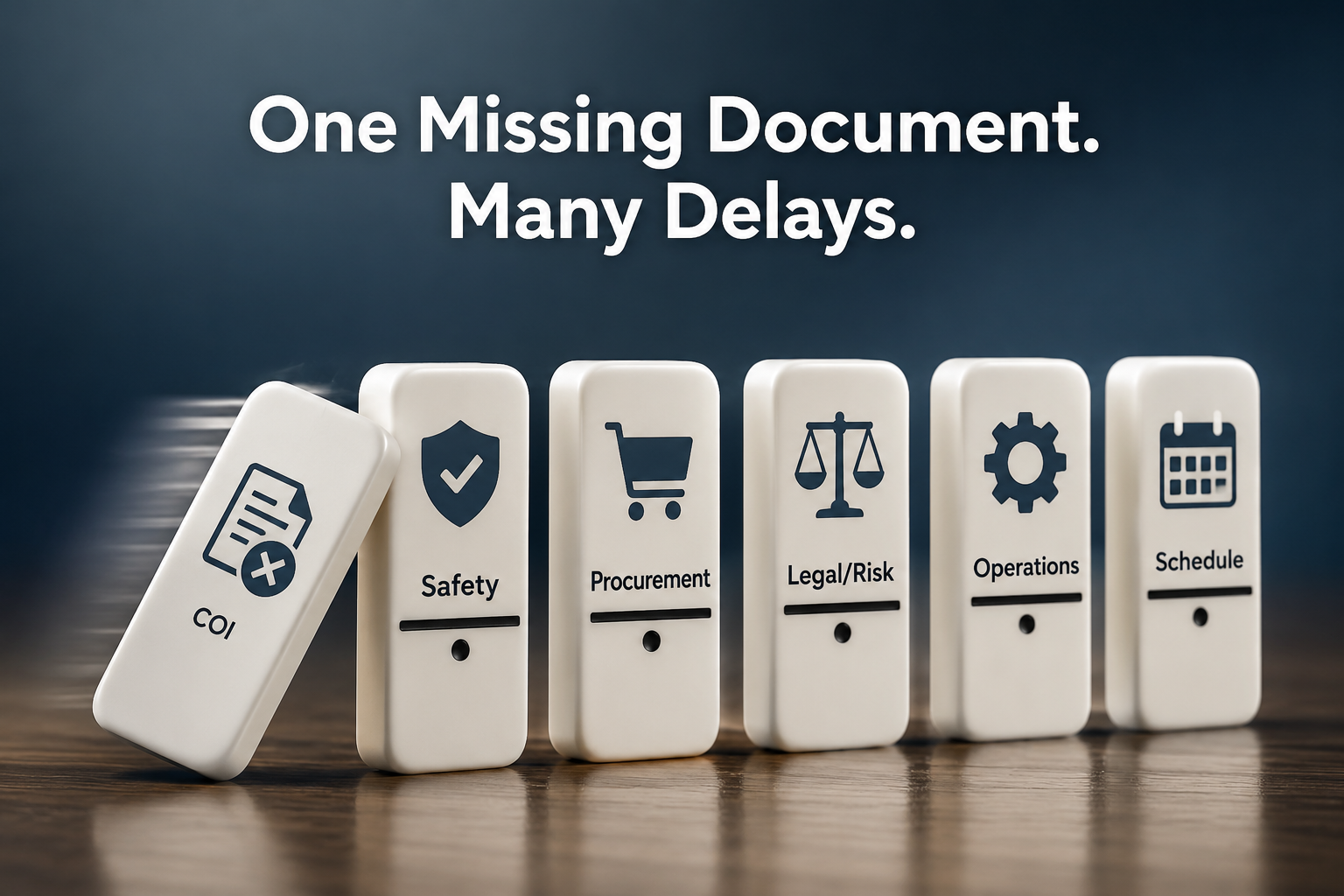
Most organizations already collect information about their contractors. Procurement may have business records and agreements. Risk may maintain certificates of insurance (COIs). Safety may review prequalification information and orientation records. Security may keep an entry log. Operations may know which contractor crews are expected that day. Each department sees one part of the picture.
The difficulty is that expected attendance, approved status, orientation completion, and actual presence are not the same thing. A project schedule may show who was supposed to arrive. A training report may show who completed orientation. A prequalification record may confirm the contractor’s current status. None of those records, by itself, establishes whether a particular person is inside the facility at 2:15 p.m. This is where information flow becomes an operational issue.
When systems are disconnected, people compensate through phone calls, emails, radio messages, and personal knowledge. That can work during routine operations, particularly at smaller locations. It becomes less dependable when shifts overlap, several entrances are used, or contractor activity increases. The weakness is not necessarily the people involved. It is the design of the process.
A sign-in sheet records an action, not a complete status
Paper logs have survived for good reasons. They are inexpensive, visible, and require little explanation. They also depend heavily on consistent behavior.
A person must enter a readable name, use the contractor’s correct company name, record an accurate arrival time, and remember to sign out. Security personnel must recognize duplicate or incomplete entries. Someone must then interpret the sheet if the information is needed.
A paper record can tell you that a name was written down. It cannot readily show whether the contractor is prequalified or whether the employee completed required site orientation. That distinction matters at the gate.
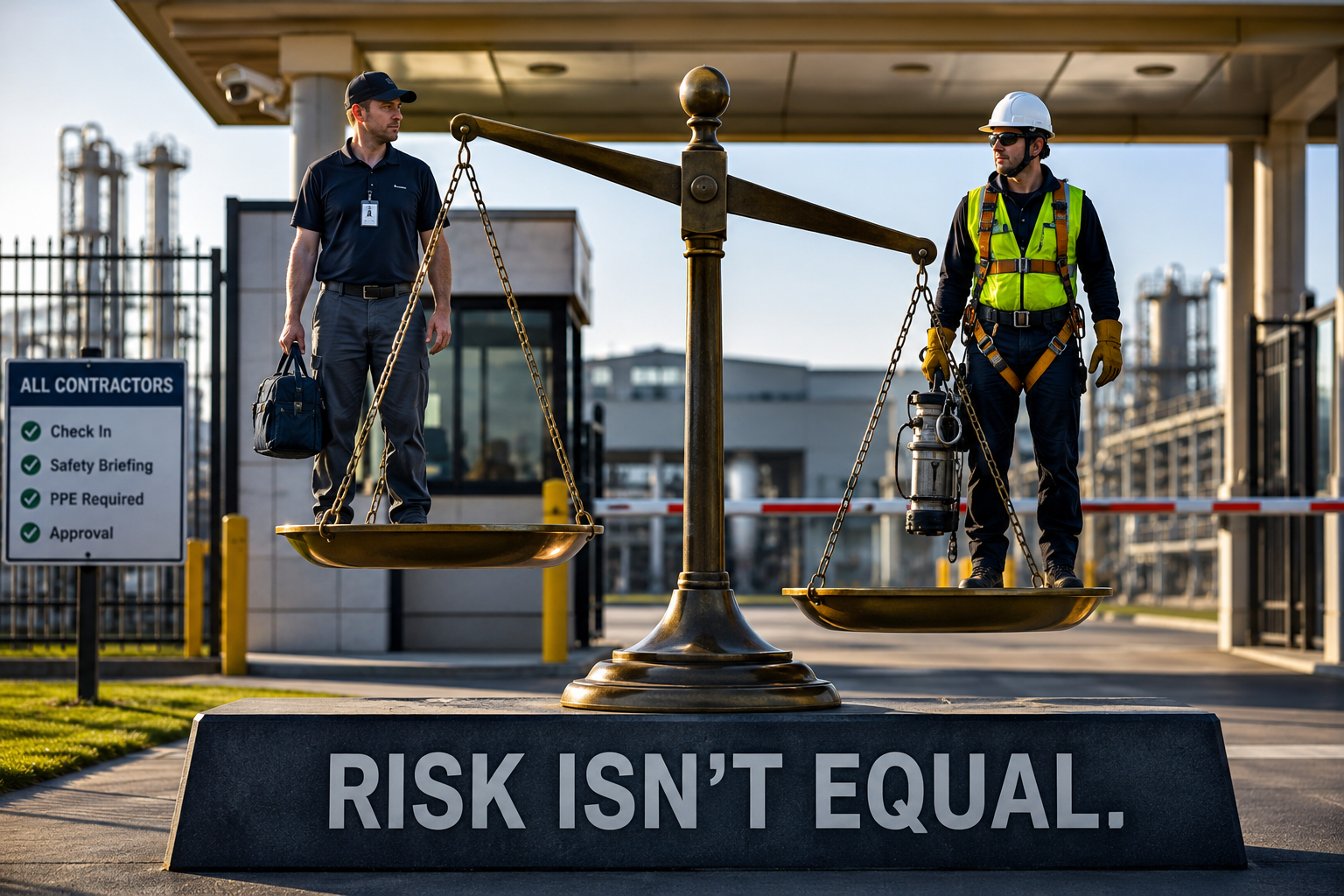
Suppose a contractor employee arrives for maintenance work. The security officer can see the person’s identification and perhaps find the company on an expected-arrivals list. But can the officer determine whether the contractor’s prequalification is current? Can the officer confirm orientation completion without contacting Safety or Operations?
When those answers require several separate checks, the access process becomes slower and less consistent. People begin relying on workarounds, especially when production schedules are tight or a contractor is waiting with equipment at the entrance. Over time, exceptions can become the normal process.
Visibility is useful only when the organization defines what to do with it
A contractor check-in/check-out system can connect arrival and departure records with selected compliance information. Within FIRST, VERIFY’s optional Onsite/Offsite system, authorized personnel can check contractor employees and visitors in and out, search by employee, contractor, or visitor name, and select the relevant business unit and location. The system can display whether a contractor is prequalified and whether an employee has passed a required safety orientation. That solves an information problem. It does not, by itself, solve a management problem.
A facility still needs a policy for what happens when a contractor is not prequalified or an employee has not completed orientation. Security personnel need to know whether to deny access, contact an authorized manager, or follow another escalation process. The software presents a status. The organization assigns meaning to that status.
This is a broader lesson in compliance management. More information does not automatically produce better decisions. Useful information must arrive at the right point in the process, and the person receiving it must understand the next action.
Orientation records become more valuable at the point of entry
Many companies have improved contractor onboarding by moving site orientation ahead of arrival. FIRST, VERIFY can host site-specific orientation content, including videos, quizzes, policy acknowledgments, completion certificates, reporting, and renewal reminders. Results can be viewed by contractor, employee, course, and date.
The operational advantage is not simply that a course was completed online. The greater value comes when completion can be confirmed where the information affects a decision. A training record stored in one department is useful for documentation. A visible orientation status at check-in is useful for operations.
The distinction should still be kept clear. Site orientation does not establish that an employee is qualified for every task. It does not replace hazard-specific training, required licenses, supervision, or the contractor employer’s responsibilities. It answers a narrower question: has this person completed the site orientation required for entry? Narrow questions, answered reliably, often improve systems more than broad claims of “complete visibility.”
Emergency drills reveal whether the process reflects reality
OSHA’s emergency action plan requirements include procedures for accounting for employees after an evacuation. OSHA also recommends that workers, including contractors, be trained and drilled on emergency communication and response procedures. (OSHA)
A contractor roster is not the same as an onsite list. Neither is an orientation report, a work order, or a list of people expected to arrive. During an evacuation, the relevant question is who entered and has not yet recorded a departure. The Onsite/Offsite system can generate a downloadable “currently onsite” report for contractor employees and visitors to support emergency evacuation drills. That report should be treated as part of the accountability process, not as proof that the process is working.
During a drill, compare it with the people present at assembly areas. Look for names that are missing, people listed after they have left, and individuals who entered through an unapproved location. Those discrepancies are useful. They show where procedures, communication, or human behavior differ from the process as designed. A drill that reveals three errors may be more valuable than one that produces a perfect report no one has tested closely.
Consistency matters more than complexity
The most reliable check-in processes are usually straightforward. Organizations need to define who must check in, where entry and exit should occur, and who is responsible for recording the activity. They also need a practical method for handling exceptions.
Facilities with several entrances should be especially careful. A strong procedure at the main lobby offers limited value if contractor crews routinely enter through a maintenance gate without following the same process.
Authorization is another practical consideration. Third-party security personnel may need to see prequalification and orientation status without having access to unrelated contractor information. FIRST, VERIFY supports authorization levels that can limit what particular users see.
This is a useful example of organizational design supporting compliance. People should have enough information to perform their role, but not broad access simply because the underlying systems are connected.
The real test is whether the process answers a simple question
Contractor check-in/check-out is not a complete contractor management program. It does not replace prequalification, orientation, supervision, emergency planning, or facility access policies. Its value is more practical. It connects the contractor information collected before work begins with the person who actually arrives at the facility. It helps authorized personnel see relevant status information at the point of entry. It also creates a record that can support contractor and visitor accountability during evacuation drills.
OSHA’s recommended practices emphasize communication and coordination on worksites involving more than one employer. (OSHA) In practice, that coordination depends on how well information moves between departments and how consistently procedures are followed.
The question for EHS, Risk, Security, and Operations leaders is therefore not whether the organization possesses contractor information. It is whether that information can answer the question that matters when the alarm sounds:
Who is onsite right now and how confident are you in the answer?
Contact
FIRST, VERIFY to learn how we can help track your contractors.
You might also like